
New Blog: Who is open source about?
116
Discussion
New Blog: Who is open source about?
@zzzeek @glyph I find the assertion rather dubious too. There is a subculture of people who really hate AI and will mog any project that shows any affinity.
However, I’m pretty sure the vast majority of users doesn’t give a flying fuck how software is developed, as long as it’s ~working~. This is not a value judgement from my side, it’s just an observation. The anti-AI subculture obviously blames AI for every new bug in those projects, but the real “mainstream” backlash is still to happen.
@hynek @zzzeek @glyph Perhaps users are too tired from the onslaught of enshittification in software and services to have time to think about how the sausage is made, and honestly, until I started explicitly looking for certain hallmarks in repos I didn't realize how pervasive it was either.
The pushback seems pretty vocal in non-coding instances, but I think you're assuming a certain expertise to consider how applications are made. If people who lived next to the xAI Southaven, MS data center knew it was also chewing out Claude commits, maybe they'd be annoyed at software, too.
@tehstu @zzzeek @glyph I find it quite natural to not care how the software sausage is made until I have a (usually negative) reason to; no need to be specifically tired. Maybe that will change once we have some serious implosion in FOSS land due to AI usage but until then people are busy with more urgent crises to care for now.
@hynek @zzzeek the most recent example was KDE, but there have been similar debacles with keepass and calibre, both of which resulted in forks. the kernel also took a lot of heat, but the kernel and KDE are TBTF so nobody is realistically forking those. similarly rust’s policy discussion made people big mad
@hynek @zzzeek AI is far more popular among long-term maintainers than it is among users, so the more user-facing a project is the more likely this is to happen. the deeper into a specific middle-stack infrastructure niche you are, the more likely all your proximate consumers are equally vibesick and don’t care
@hynek @zzzeek the bubble where I live, I guess, so I can’t say for sure otherwise. but my glimpses outside it strongly imply to me that the general public is actually much madder about AI in general, and the only reason you don’t see more of this is that open source itself is pretty unpopular. but the worlds do touch every so often. c.f. libreoffice breaking all their download records; there aren’t enough people on bsky and fedi to do that
@glyph @hynek I guess we're going to find out but I *strongly* disagree the *general* public is "madder about AI". maybe urban/rural split, but not locals that aren't on bluesky all day. Everyone in my non-urban area is either "I dont know much about it" or they're like "yeah im on Open AI all day I ask it everything". the facebook groups are just nightmares of AI posters and slop (with zero pushback) Have seen zero anti-AI sentiment locally. Now in the Park Slope Food Coop, totally different.
@zzzeek @hynek polling data is extremely noisy and often motivated, but there are some indications that concern is growing generally https://www.yahoo.com/news/politics/articles/cnn-poll-3-4-americans-184958573.html
@zzzeek @hynek you can easily find polls, especially global polls, that say that everybody actually loves AI. I tend to think that these are somewhat worse methodologically but it’s not like anyone is doing a *good* job. and people in south korea and china are legitimately much more positive than in the US https://hai.stanford.edu/ai-index/2026-ai-index-report/public-opinion
@glyph @hynek you can talk about the environmental / worker impacts of AI and you have an argument there but saying everyone that's using claude or chatgpt is experiencing direct harm, you're just not going to get much traction on that argument, sorry. We can go back to the "meat" argument for this too (red meat causes cancer). the problem here is that there's a ton of *benefit* to these tools which has to be considered, and the reflexive AI haters refuse to consider
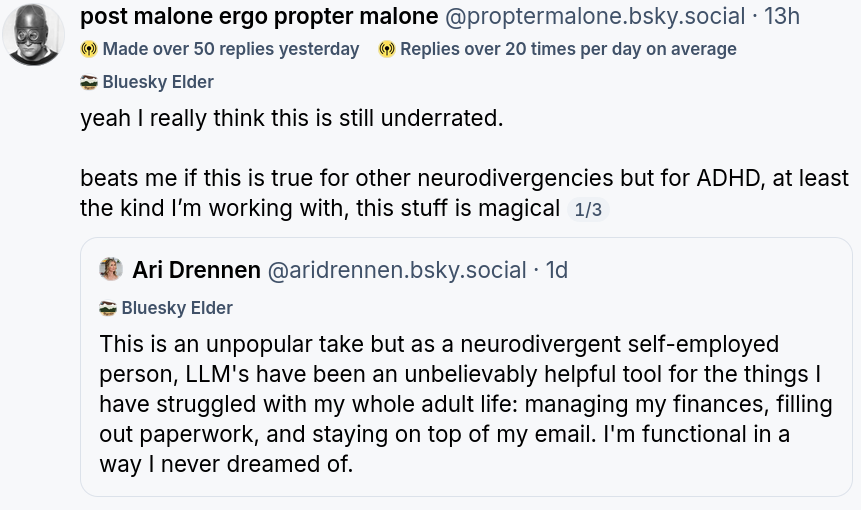
@glyph @hynek it's frankly getting to be annoying that experiences like that pictured below are shrugged off with "they're in a cult, they're not actually any more productive and are simply under mass delusion (of course *they* are, not *me*), they're actually being harmed, and also fuck their "convenience" because a worker was harmed at some point" this is not a balanced viewpoint
@glyph @hynek the reason AI haters really refuse to consider any possible benefit is because then every negative externality of AI is no longer a "therefore it must be abolished", it now becomes a much more complicated question of balancing cost/benefit. I'm interested in the cost/benefit discussion and that gets into things like "what kinds of practices should be encouraged/discouraged on github" etc. but we're stuck with this head in the sand thing
@eevee @zzzeek @hynek also, it is extremely rich to say this specifically to me, the person who has been flogging my extremely in-depth article about tradeoffs for an entire year now https://blog.glyph.im/2025/08/futzing-fraction.html
@glyph I enjoyed this article.
I think the “reasons for open source” section appears to be missing, “Because fuck it, why not,” as a reason.
I.e. I wrote this for me, it's useful for me, I've stuck the code on the Internet just in case it's useful for someone else at some point.
@glyph There's a motivation (mine!) that I can't match to any of the ones you mention - social connection. I publish open source because I made a neat thing that I'd have liked if I found it on the Internet. If others find it interesting or useful (better still if they interact with me about it) then great, I meet new people.
If their motivations and needs differ from mine, that's something we can connect over and discuss. But if they just want me to solve their problem, I'm not interested.
@pfmoore this is *briefly* touched on by the "external feedback" and "secrecy" point within "influence". I could expound somewhat, but the benefit of open source specifically (as opposed to just "work at a big company with a lot of people in it") is that you can meet and interact with people *outside* your company.
@glyph Yes, but for me at least, my open source work has almost exclusively been nothing at all to do with "my company". For most of my career my role involved little or no use of open source I was involved in.
@pfmoore I still feel like this fits neatly into my framework (if you want to interact with people outside your company then outside of work is a fine time to do it!) but if you disagree that works great for me, my goal was to get people thinking about what motivates them and what obligates them and I think I have succeeded massively given replies like this :)
@glyph
This clarified a thought I've had for a while: There isn't one "open source".
At one end is a single person going "Here's some code I wrote. Check it out or something, IDK".
At the other end is big, funded projects with backing organizations, that *aim* to be widely used.
They signal very different expectations about quality, maintenance and support. And we should be able to treat them differently as a result.
@glyph Finished, solid post as usual.
@glyph "Security Updates Are Just Command And Control In A Funny Hat"
THANK YOU!
This one goes places.
In particular, it is literally time for some game theory.
This was a post that was very satisfying to publish because it reversed the trend of posts that I start on that are too large and ambitious to ever finish, and instead turned into a post that got *3* ideas out of my head that have been stuck in the drafts all at once instead of needing to be split up into 20 parts (implicit social relationships in open source, ethical game theoretic implications of maintainership, how to address users howling in psychic pain from open source code changes)
@glyph thank you for this :>
oh wait. 4. also how your chart of accounts should reflect your OSPO

Install bonfire.mavnn.eu
Get the full app experience











@glyph unfortunately I'm not familiar with the cases you wouldn't link, with "a ton of angry users showed up to yell at developers to stop accepting LLM-generated code." I've actually not seen that at all, do you think such a thing is inevitable once the users figure out a project uses AI ? Even like the Linux kernel? or is it based on poor maintenance facilitated by AI?
Was hoping the post was going to be about DHH TBH