I know I just shared photos of my #cats, but you have to see these ones I was sent today.
#catsofmastodon #Zele #Athina
2 media
Discussion
I know I just shared photos of my #cats, but you have to see these ones I was sent today.
#catsofmastodon #Zele #Athina
“Believing that a population will “rise up” with no weapons or structures against a bloodthirsty regime that killed tens of thousands of them only a few weeks ago takes a special kind of stupidity.”
RE: https://bsky.app/profile/did:plc:rw2kfkoa7dvxmip5rm4nay7x/post/3mga6edow3k2o
@chrischirp.bsky.social, we drew on your essential UCL Policy Lab report on Strengthening the Institutions (which should be widely read and heeded!) in this @[email protected] report on the BBC.
RE: https://bsky.app/profile/did:plc:izyv7k3ussysmqonmcqe76li/post/3mga3fmxnak2l
Our summary recommendations for defending the BBC’s independence and increasing its accountability are here:
demos.co.uk/wp-content/u...
demos.co.uk/wp-content/upl...
In short: - remove 10-year limit on the BBC’s Charter - streamline & modernise Reviews of the BBC - recognise BBC as public interest tech organisation - make Board appointments independent - take funding decisions out of political control - involve citizens in governance
You can send an email to DCMS in response here (short and narrowly-targeted responses are helpful - you don’t have to respond to every question in the Government’s questionnaire):
www.gov.uk/guidance/ema...
Emailing a response to the BBC...
Our summary recommendations for defending the BBC’s independence and increasing its accountability are here:
demos.co.uk/wp-content/u...
demos.co.uk/wp-content/upl...
Deliberative democracy folks: the UK government is taking inputs on the future of the BBC till 10th March - and they’re asking how to involve citizens more. Here’s the proposal I led for @[email protected], including a ‘public lock’:
demos.co.uk/wp-content/u...
demos.co.uk/wp-content/upl...
You can send an email to DCMS in response here (short and narrowly-targeted responses are helpful - you don’t have to respond to every question in the Government’s questionnaire):
www.gov.uk/guidance/ema...
Emailing a response to the BBC...
Deliberative democracy folks: the UK government is taking inputs on the future of the BBC till 10th March - and they’re asking how to involve citizens more. Here’s the proposal I led for @[email protected], including a ‘public lock’:
demos.co.uk/wp-content/u...
demos.co.uk/wp-content/upl...
1/ Experts issued some pretty dire warnings about Trumpian tariffs and Brexit, and the result was not nearly as bad as it could have been. Now they're issuing dire warnings about Iran. A much smarter friend asked me how I was thinking about the difference. My short answer: control.
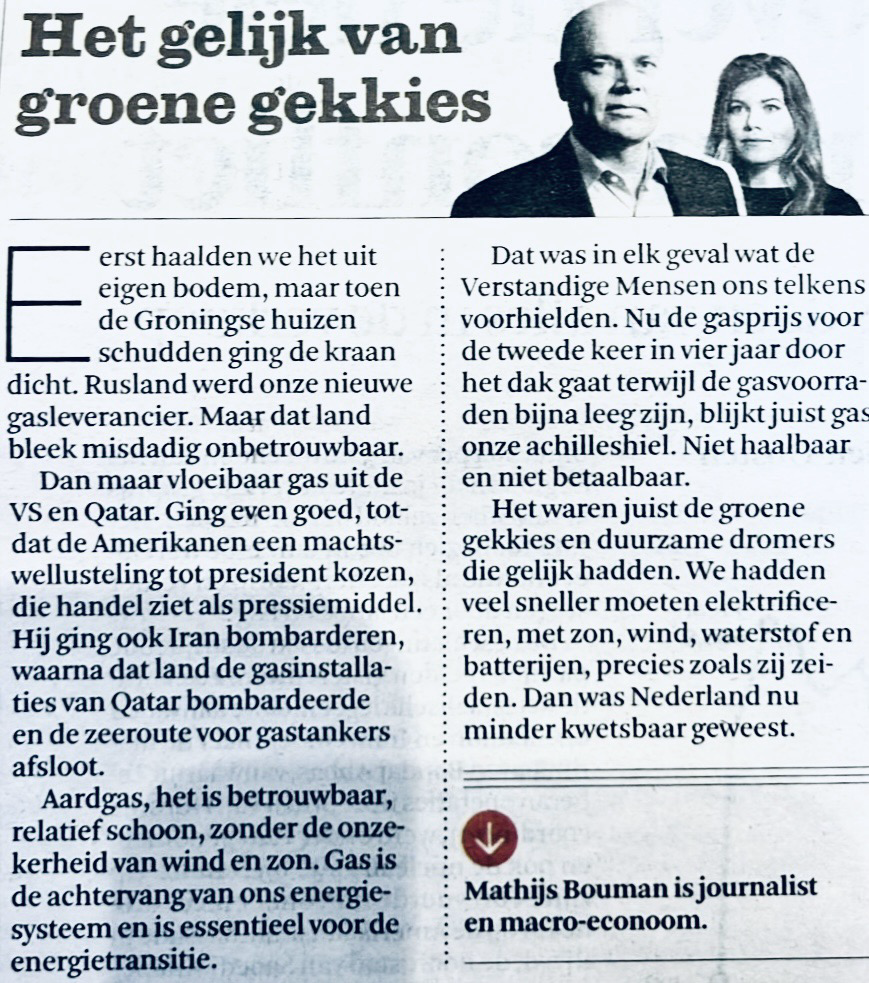
Horen jullie het ook eens van iemand anders, van @mathijsbouman in het FD namelijk: Juist de groene gekkies hadden gelijk. “We hadden veel sneller moeten elektrificeren, met zon, wind, waterstof en batterijen, precies zoals zij zeiden. Dan was Nederland nu minder kwetsbaar geweest.”
So, in launching a huge bombing campaign on Iran they apparently didn't plan for: - Who takes over; - Interceptor shortages from sustained drone retaliation; - How to defend US bases in the region; - Threats to ships in the Strait of Hormuz; and - How to evacuate Americans with airspace closed.

This is so good, we wish WE had made it! The history & lunacy of the disinformation campaign around 15-Minute Cities, by 2 “non experts” @[email protected] & @[email protected] who show how experts SHOULD be communicating. Thanks to the @[email protected] podcast. #UrbanTruth
15-Minute Cities – How Urban D...
YouTube
Stewarding the Digital Commons
Beyond the extractive models of venture capital and the burnout of unsupported altruism lies a third way: stewarding our essential digital infrastructure as a commons. Let's build a sustainable future for open source.
Table Of Contents
Our digital world is built on a foundation of critical infrastructure that is largely invisible, often thankless, and dangerously precarious. As I wrote recently on my personal blog , the story of open-source projects like Reticulum is a stark reminder of this reality. We depend on the brilliance and dedication of a few individuals who often work for years with little to no financial support, only to face burnout and disillusionment.
This is not a sustainable model. It is a tragedy of the commons, where we all benefit from a shared resource but fail to collectively maintain it. The typical solutions offered are themselves part of the problem. We are told that for a project to be “serious,” it must attract venture capital, which, as my critique of the DePIN space shows, inevitably transforms a mission into an asset to be stripped for value. The goal shifts from utility to exit liquidity.
We need a third way. A post-corporate model for funding our future. We need to stop thinking like consumers or investors and start thinking like stewards.
What does it mean to be a steward? It means recognising that some things are too important to be owned by any single entity. It means understanding that our role is not to extract value, but to ensure the long-term health and availability of a resource for generations to come.
Projects like Reticulum are not products; they are infrastructure. They are the digital roads and bridges of the 21st century. We don’t expect a bridge to generate 10x returns for venture capitalists. We understand it as a public good, funded and maintained for the benefit of all who use it. We must begin to see our most critical open-source software in the same light.
This requires a new set of funding and governance structures that are purpose-built for the commons.
Imagine a “Digital Commons Trust” for a project like Reticulum. This is not a corporation or a traditional non-profit. It is a legal and financial entity with one single purpose: to ensure the continued development and maintenance of the open-source project in alignment with its stated principles.
How would it work?
This model is a direct challenge to the corporate logic that has failed us. It rejects the idea that shareholder value is the only metric of success. It creates a space for patient, long-term development, free from the pressure to pivot, “monetise the user base,” or sell out.
It is a key strategy for what I have called “reclaiming our systems .” If we want a future where critical infrastructure is not controlled by a handful of mega-corporations, we must build and fund the alternatives ourselves. We cannot wait for the market to provide solutions, because the market is designed to create dependency, not freedom.
The choice is clear. We can continue down the path of extractive, venture-backed hype cycles that leave a trail of e-waste and broken promises. Or we can take responsibility for the digital commons we all depend on. We can become stewards of our own future.
It will require effort, coordination, and a shift in mindset. But the alternative—a world where every piece of our digital lives is owned and controlled by someone else—is far more costly. The time to start building these new institutions is now.
Attribution: Image by Conall, CC BY-NC-ND 2.0 Visit here
Congrats University of Waterloo for leaving X! Make sure to follow them here @[email protected]
To my surprise, the State Police response to my public records request included more than an hour of video taken from the helicopter over the protest at the federal building on January 10. Potentially of interest, there were -four- people on the roof of city hall. They operated the drone. 1/?
Refreshing social media every few minutes to discover if Trump has bombed Iran, Cuba, Anthropic or the Supreme Court.
#RIP Dan Simmons, author of one of the greatest #scifi series of all time, The Hyperion Cantos. A work of genius. arstechnica.com/culture/2026...
"HHS under Kennedy has made a habit of throwing good money after bad science. ... there has been a harmful shift in priorities. Cutting-edge discoveries and clinical investigations are denied crucial resources while junk science and fringe beliefs are elevated without justifiable explanation."
RE: https://bsky.app/profile/did:plc:z6rujpf4u56jfie7aqic2nfg/post/3mftlibsgus2u
RE: https://eupolicy.social/@finnmyrstad/116141082378515849
Here a small movie by the Norwegian Consumer Council inspired by @pluralistic
@kirschner @pluralistic Brilliant. Nodded my head all the way through the video. Every word spoken in truth. #EnshittificationSucks

Install bonfire.mavnn.eu
Get the full app experience