
@JessTheUnstill That was a lot of the point of SI units. An inch, a mile, a foot every measurement meant something different in each country. The base ten thing is nice but I'm pretty sure that is came after the whole "it should be the same".
A Swedish mile is 10 kilometers. Get outta here with those weak-ass American miles.
Sorry, you cannot view this.
Replies:
5

@JessTheUnstill The Wikipedia page on barleycorn has a nice diagram of the most obscure imperial units. https://en.wikipedia.org/wiki/Barleycorn_%28unit%29?wprov=sfla1
1

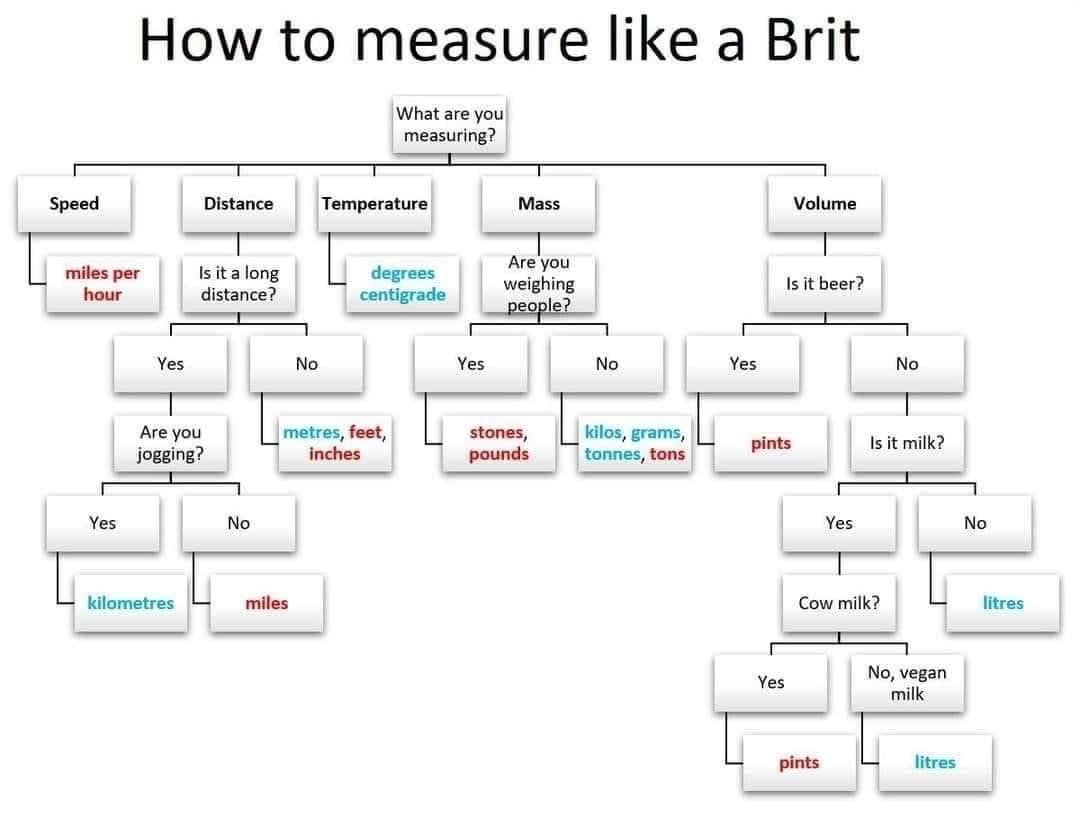
@mndflayr @JessTheUnstill How To Measure Like An American:
1. Start with "How to Measure Like a Brit", but throw out all the metric units
1a. Except things like some (but not all) drink bottles, which can be in liters, and some (but not all) hardware, optics, bullet calibers, and a few other things, which can be in mm or cm
1b. Also throw out stones. Americans react to stones the same way the rest of the world reacts to degrees Fahrenheit: "WTF is this shit?"
1
@mndflayr @JessTheUnstill Mildly spicy take: once you get to units larger than a certain point, the US customary system of units isn't totally brain-dead, because there's a certain largish unit that's only ever handled decimally at that point.
Length: miles (your GPS will tell you you're 62.43 miles from your destination, not 62 miles, 3 furlongs, and some weird number of feet or yards)
Volume: gallons (a silly unit, but at least your gas tank is sized at, say, 14.3 gallons and not 14 gallons, X quarts, Y pints, and Z cups)
Mass/weight: pounds, unless you're dealing with weights big enough to merit counting in tons. Most modern scales in the US report weights in decimal pounds, not pounds + ounces.
It's the smaller end of the scale that's most thoroughly effed up (inches/feet/yards, teaspoons/tablespoons/cups/pints/... etc.)