@stylus - people do indeed develop just intonation scales that are more complex than the historically important one I explain.
In Pythagorean tuning, all the frequency ratios are of the form
2ᵃ 3ᵇ
so this is also called 3-limit tuning.
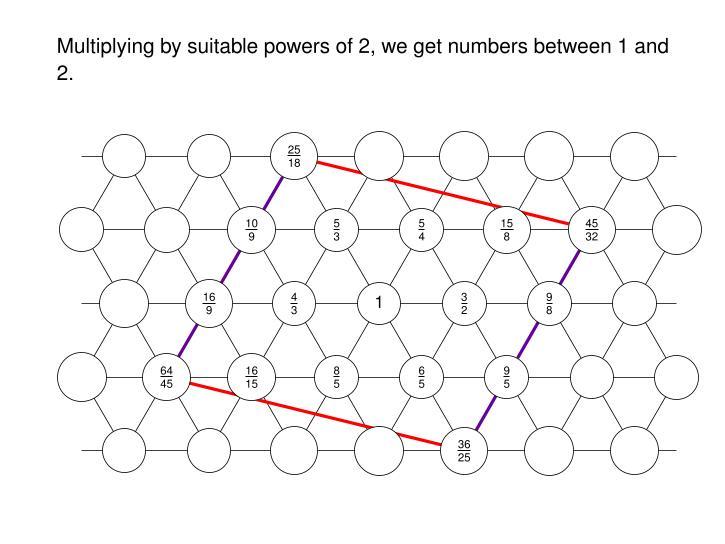
In the just intonation I explain, they're all of the form
2ᵃ 3ᵇ 5ᶜ
This is 5-limit tuning.
People have gone on to study 7-limit tuning, 11-limit tuning, etc.
You're making me wonder if one of these, preferably involving not too many of these, could fit well with a 29-note scale. Maybe, as you suggest, 5-limit tuning or even 3-limit tuning could do the job!
This is a great math question, and I haven't seen anyone discuss it. But I've mainly been interested in the historically widely used systems. To explore the wild universe of mathematically possible systems, this is a good resource:
https://en.xen.wiki/w/Main_Page
Maybe the answer to your question is lurking in there.
"Finally, just an observation: It's unusual to see a discussion of tuning without an appeal to the overtone series somewhere. I assume this was a conscious decision."
Yes: my talk will be just 50 minutes long. After a run-through of basic harmony concepts to get the non-musical mathematicians in my audience up to speed, I think I'll just barely have time to explain Pythagorean tuning and just intonation. I want to explain them slowly and clearly enough so it sticks.
If I had two hours I could say a bit about *why* rational numbers are a big deal (this is more physics than math), and also delve into the wonderful world of quarter-comma meantone:
https://johncarlosbaez.wordpress.com/2023/12/13/quarter-comma-meantone-part-1/
I like to think someday I'll write a short book about this stuff.