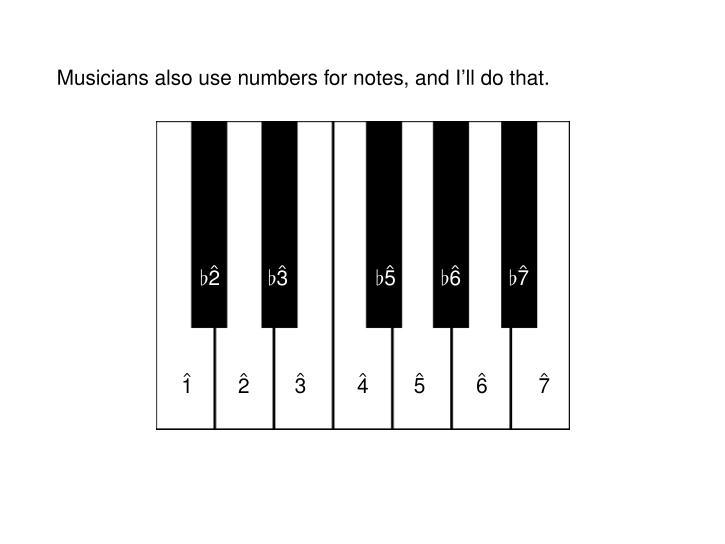
@j_bertolotti - You're a smart guy, you can handle it. Yes a fifth is 7 semitones up, but it's the 5th tone. "Semitones" are the white and black keys, but "tones" are the white keys. White keys are the basic stuff of the major scale.
@johncarlosbaez The very fact that people decided to divide notes into "white" and "black" instead of simply say that they are ultimately all semitones is also something that will confuse me forever 🤣
@j_bertolotti - You're joking, but this stuff is serious to me. You sound like a physicist who is confused by the difference between kinetic energy and momentum. So I have to try to save you.
As I explained in my talk, the white notes were around long before the black notes were even invented. If you're singing "Happy Birthday" or some other simple song, you never need the black notes. The white notes form a simple and beautiful 7-note scale.
Around 1200 AD people started using extra notes, for good reasons which I could explain. These were first called "musica ficta", or "false notes". People added them to the keyboard as extra black keys. They're important only when you try to play more fancy music.

@johncarlosbaez I didn't mean to offend you. If I did, I apologize.
I understand this stuff on an intellectual level, but I never devoted nearly enough time to music to make this stuff less confusing at an intuitive level. There is just too much historical baggage.
@j_bertolotti - You didn't offend me. I just feel bad when someone jokes about how they don't understand something: I feel something between wanting to help them and being annoyed that they're not wanting help.
The "historical baggage" of music is the fabric of music itself, how it unfolded from simplicity to complexity. Most musicians don't know when black keys were invented: that's not very important. But they intuitively know - from playing music - that the black keys are "fancy", and that the white keys form their own simpler system which is good enough for a large chunk of music. So it makes perfect sense that we use a numbering system based on the white notes, and think of the black notes as "extra" notes stuck in between those.
Can you sing "do re mi fa so la ti do"? Those are the 7 white notes (technically the "diatonic scale"). It's a lot easier to sing this scale than the 12-note scale including the black notes.
@johncarlosbaez @j_bertolotti
The circle of fifths helps clarify the topic. In fact for most western music it is essential to master thinking in terms of it (despite the "contradiction" that, descending in the other direction, it's the circle of fourths).
None of this is illogical, not one little bit. The *terminology* of course derives from historical accident.
@dougmerritt @j_bertolotti - I was trying to explain to Jacopo that the terminology is not a historical accident in the sense of "a stupid thing that just happened by accident, that now we just have to painfully memorize". It took me a while to figure out the simplest explanation, but I think I have it now:
When you sing "do re me fa so", the fifth word here is called the "fifth".
News and community around mavnn.eu projects.