Quoting Gro-Tsen:
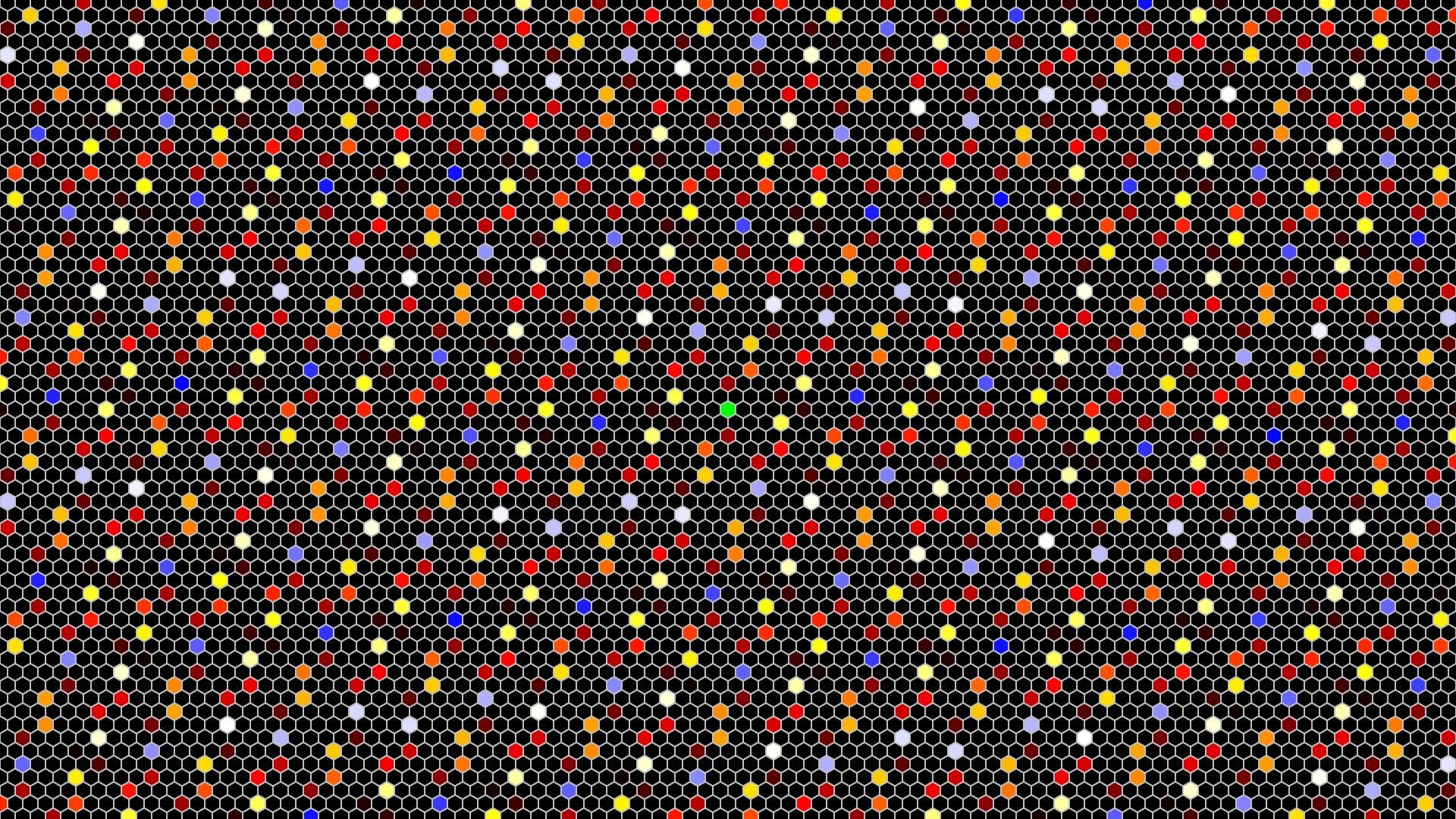
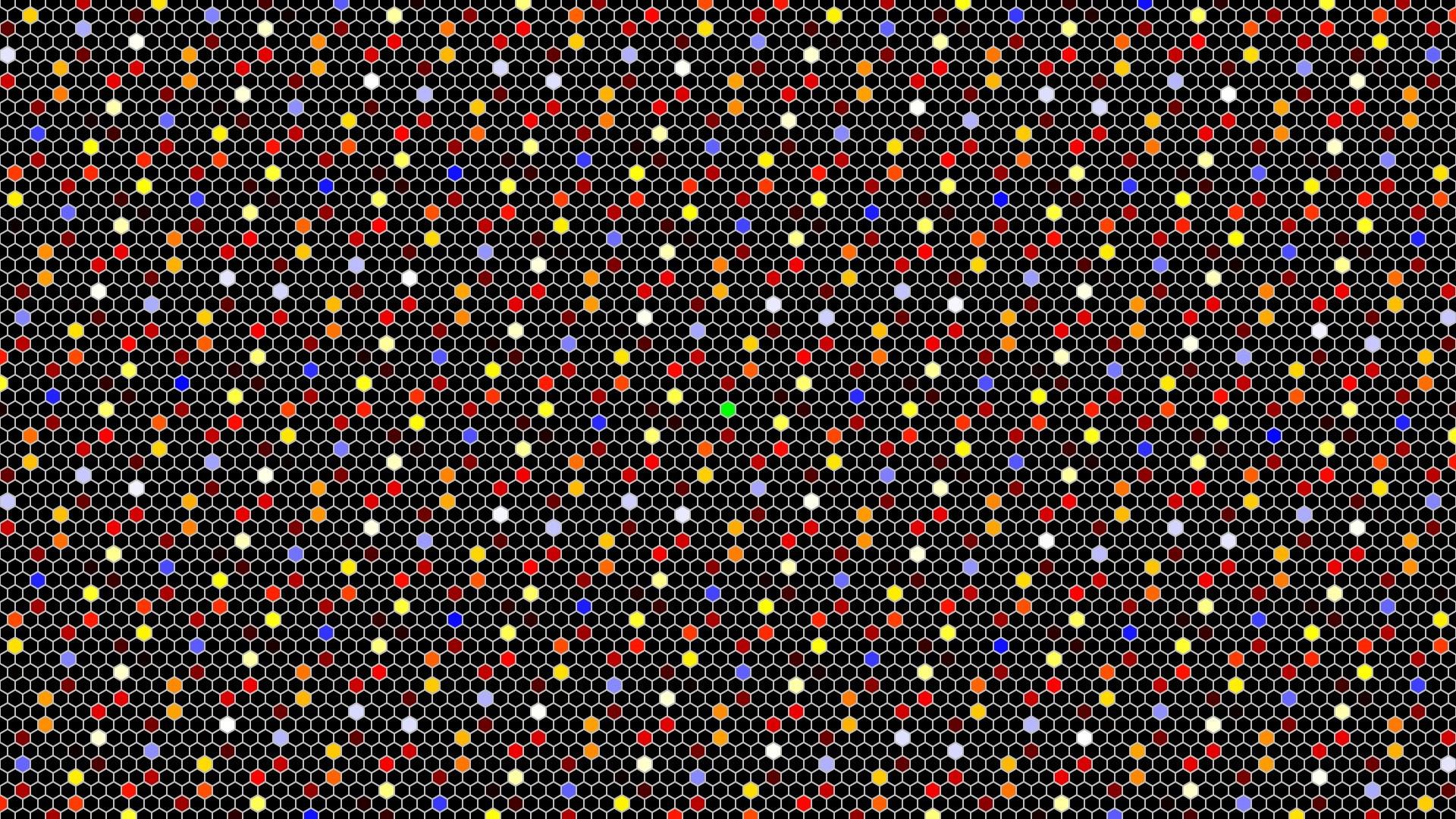
"(Yes, this is a purely arbitrary color gradient, I didn't give it much thought. It's somewhat reminiscent of star colors.) Anyway, red-to-white are good matches, and white-to-blue are pretty much inaudible differences, with pure blue representing an exact match, … except that the center hexagon has been made green instead so we can easily tell where it is (but in principle it should be pure blue).
The thing about the diagram is that it LOOKS periodic, and it is APPROXIMATELY so, but not exactly!
Because when you have an approximate match (i.e., some combination of fifths and thirds that is nearly an integer number of octaves), by adding it again and again, the errors accumulate, and the quality of the match decreases.
For example, 12 hexagons to the east of the central one, we have a yellow hexagon (quality: 23.5 cents), because 12 perfect fifths gives almost 7 octaves. But 12 hexagons east of that is only reddish (quality: 46.9 cents) because 24 fifths isn't so close to 14 octaves.
For the same reason that log(2), log(3) and log(5) are linearly independent over the rationals, the diagram is never exactly periodic, but there are arbitrarily good approximations, so arbitrarily good “almost periods”.
An important one in music is that 3 just fifths plus 1 minor third, so, 3 steps east and 1 step southeast in my diagram gives (2 octaves plus) a small interval with frequency ratio of 81/80 (that's 21.5 cents) that often gets smeared away when constructing musical scales."
(3/n)