today i'm back to reading this paper by @grimalkina about contest cultures and brilliance traps in software and I'm going to try to live tweet some notes because reading papers is hard
https://osf.io/preprints/psyarxiv/2gej5_v2
(1/?)
today i'm back to reading this paper by @grimalkina about contest cultures and brilliance traps in software and I'm going to try to live tweet some notes because reading papers is hard
https://osf.io/preprints/psyarxiv/2gej5_v2
(1/?)
@b0rk Thanks for sharing @grimalkina 's paper - this is right up my area of interest right now: https://agilepainrelief.com/where-is-ai-taking-software-development/
FWIW you might both be interested in another I saw recently, GenAI Personas: https://www.bernardjjansen.com/uploads/2/4/1/8/24188166/1-s2.0-s1071581925002149-main.pdf
@b0rk thank you for this work 😭💝 I know how much effort it is to not only read papers but live post about them!!
@b0rk @grimalkina the phrase "brilliance traps" immediately makes me think of "your scientists were so preoccupied with whether or not they could, they didn't stop to think if they should". So I guess I have to wait/read to see if my snap intuition was correct. And/or, Colonel Kurtz gone so far up the river of his own "brilliance" that it all ends up gone wrong.
first I'm curious about how "contest culture" might be defined
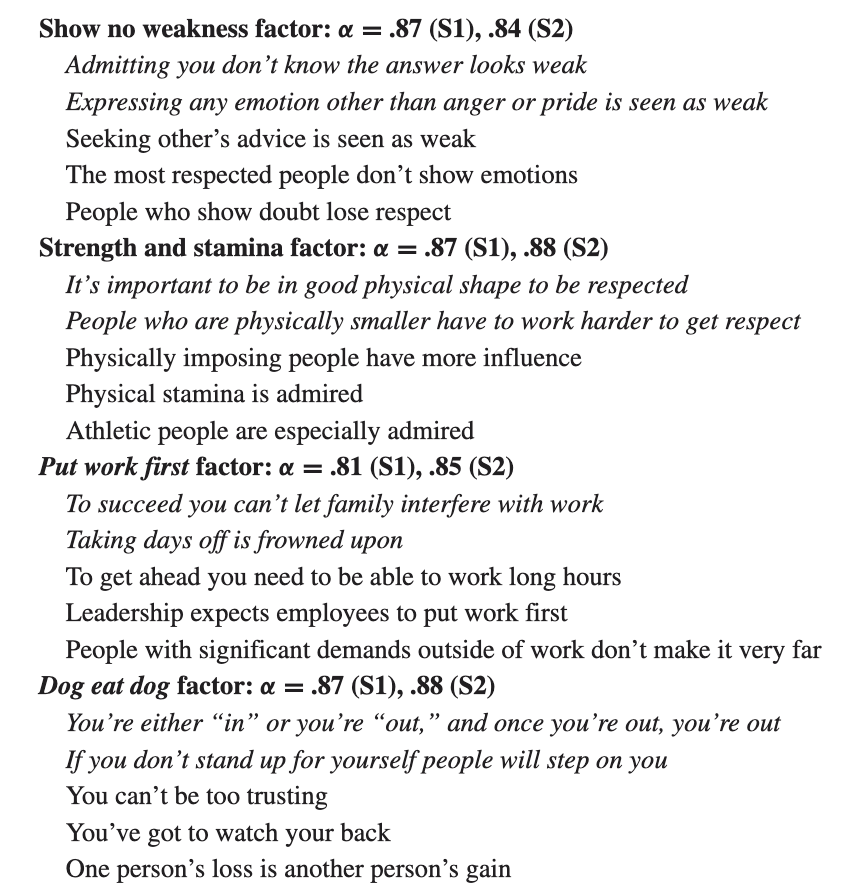
One of the references is this paper on "Masculinity Contest Culture": https://doi.org/10.1111/josi.12280 which has this list of factors
"Admitting you don't know the answer looks weak" feels VERY familiar to me, I feel like I've said "I don't know X" on the internet and been weirdly attacked for it so many times ("how could she not know that??? what does that mean about what kind of programmer she is!!!!")
(2/)
Development and Validation of the Masculinity Contest Culture Scale
"Admitting you don't know the answer looks weak"One of my favorite bits of feedback I got on a talk was "I love how confidently you said you didn't know things".
next: what does "brilliance trap" mean?
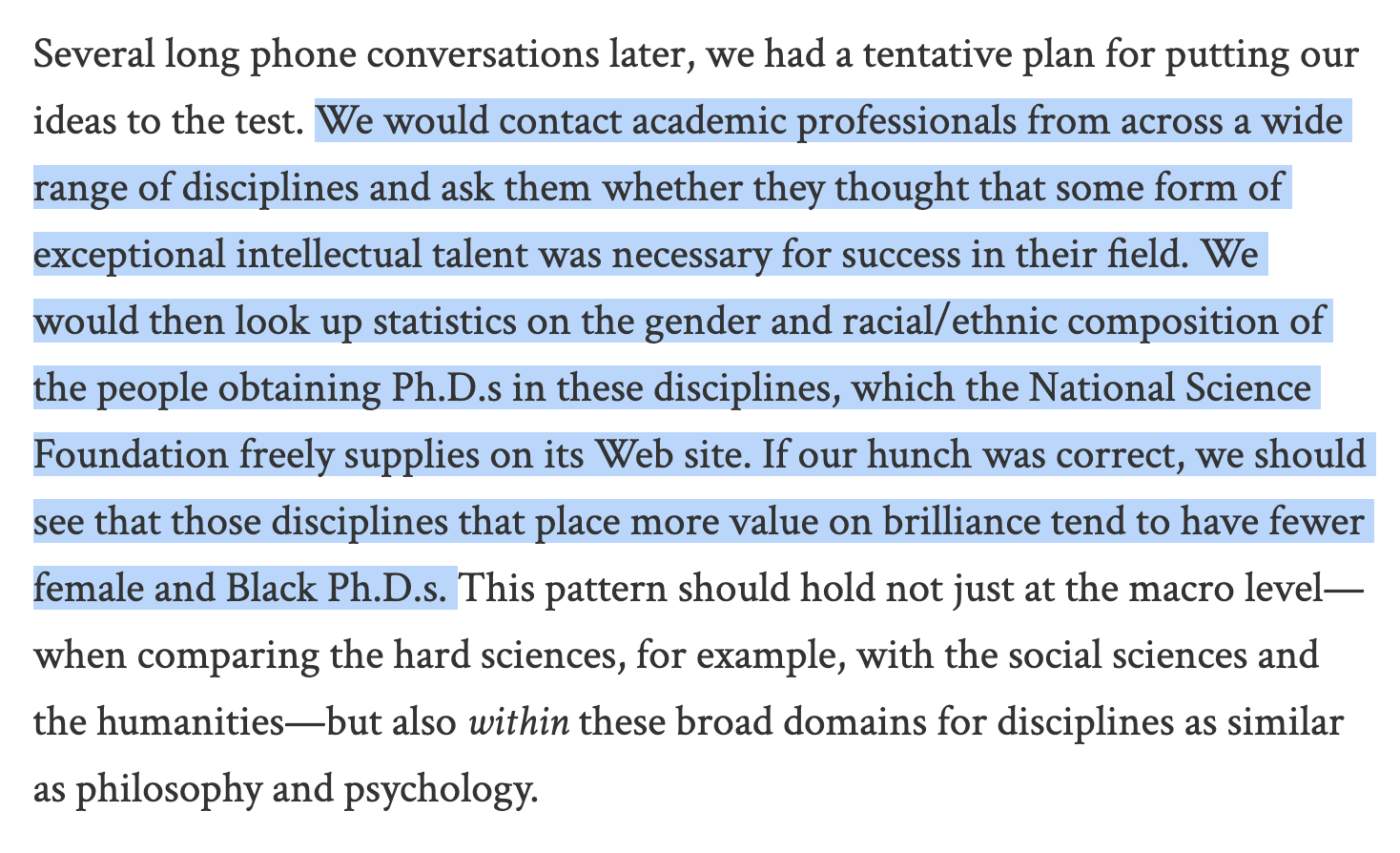
they reference this: https://www.scientificamerican.com/article/the-brilliance-paradox-what-really-keeps-women-and-minorities-from-excelling-in-academia/
which talks about a study they did on a possible explanation for why some academic fields have less women and Black people than others: the belief that you have to be innately "brilliant" to succeed in that field
(3/?)
@b0rk Praising effort rather than intelligence has been recommended practice for decades:
https://pubmed.ncbi.nlm.nih.gov/9686450/
https://www.tandfonline.com/doi/full/10.1080/01443410.2019.1625306
https://www.youtube.com/watch?v=NWv1VdDeoRY
tl;dr: praising effort leads to perseverance, praising intelligence leads to avoidance (fear of failure).
YouTube
@landley yea she talks here about how fixed/growth mindset is different from the concept of brilliance (though related!) https://mastodon.social/@grimalkina/115974677375162136
I've heard a lot in the past about Carol Dweck's "growth mindsets" (which to me is the idea that having a growth mindset makes you more _effective_ at learning than if you have the attitude that brilliance is fixed)
But I don't think I've ever heard that the attitude that "brilliance is fixed" could have an impact on representation before. that's interesting!
(4?)
@b0rk i mean, it makes sense, doesn't it? if you believe that brilliance is fixed, your brain starts looking for trends. not many women? seems like women just can't hack it. that will influence how you treat female colleagues (and especially how you treat female prospective colleagues)
@b0rk I don't remember all the details of the book, but I do think if not explicitly, at least implicitly that subject is brought up?
If I remember correctly, at least some of the example stories are about marginalised people and how the fixed mindset can affect them.
@b0rk
I’m surprised at that remark because I thought it would be obvious: even the mildest forms of racism and sexism require that individuals have innate qualities which distinguish their capacities. So it makes perfect sense they would be co-travelled. If you believe in innate brilliance you probably believe your genes are the origin.
@b0rk The phrase "brilliance trap" is also connected in my head to Dweck's points about negative effects of praise.
https://www.aft.org/sites/default/files/PraiseSpring99.pdf
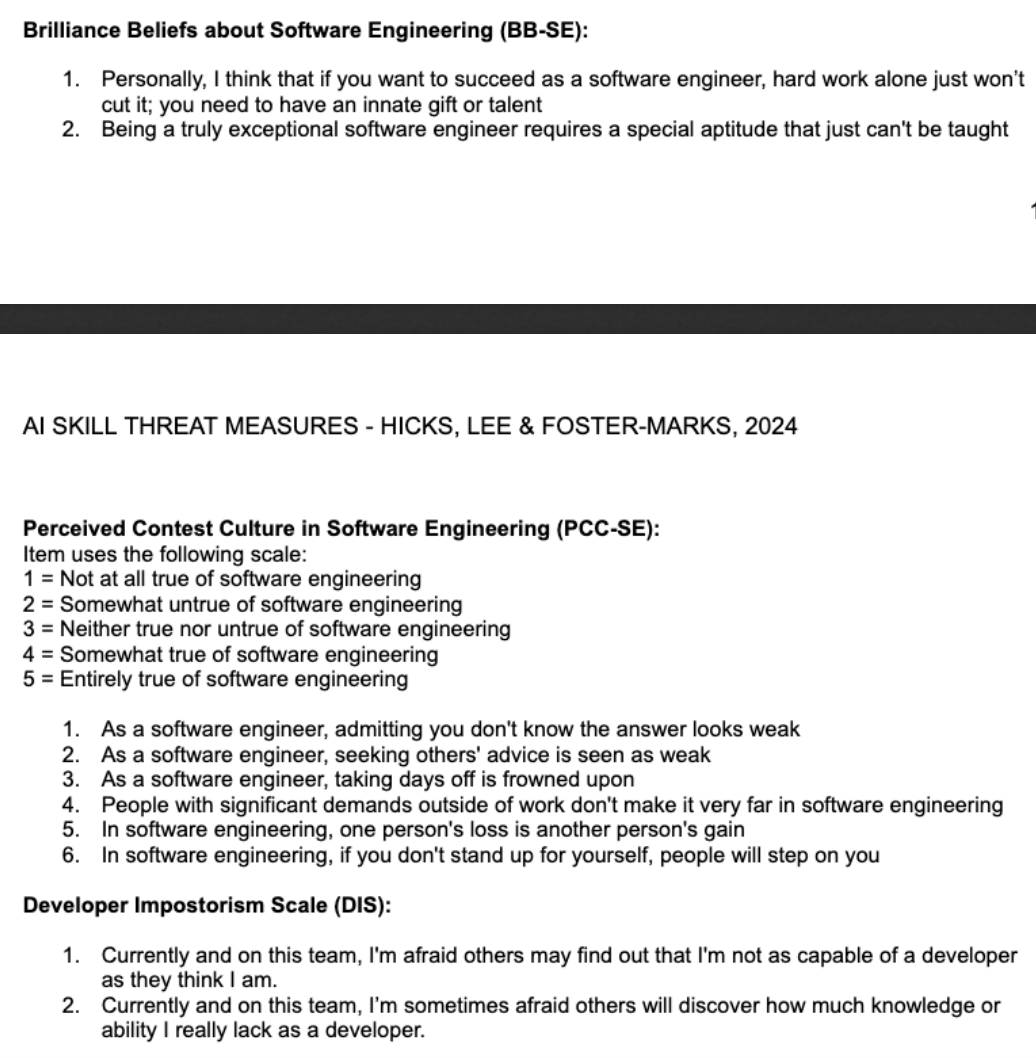
okay I'm learning (thanks to Cat's clarification!!) that they uses scales called "measures" to measure things like "contest cultures" or "brilliance belief". Cool! Here are the measures from the paper in the first tweet
https://osf.io/cd874/files/wkch8
(5/?)
@b0rk on brilliance and representation-- people have so many things wrapped up in their idea of "brilliant." Like, often "brilliant" people have bad social skills and/or are jerks. That tends to filter for the people who can afford to behave that way... who, in my culture at least, tend to be people who look a lot like me.
(I'm really enjoying this thread and the links, thank you!)
@b0rk our measures are also available in the open supplemental to the paper! (can be a little annoying to find on psyarxiv)
@grimalkina thank you!! I don't know any of this vocabulary ("measure"!), I'm so out of my depth haha
@b0rk our measures are also available in the open supplemental to the paper! (can be a little annoying to find on psyarxiv)
> how could she not know that??
Yep. Learning this ^^^ behaviour is what elementary and high schools are for. And the uni is for unlearning it