Gro-Tsen writes:
I did the math. 🙋
👉 It's Sept. 3, 32BCE (reminder: “32BCE” actually means “−31” 😒) in the proleptic Julian calendar = Sept. 1 prol. Gregorian.
The Western equivalent of the Mesoamerican Long Count is the “Julian Date” (NB: “Julian” here refers not to Julius Cæsar as in “Julian Calendar” but to the 16th century scholar Julius Scaliger). The Julian Date simply counts the number of days from an arbitrary remote reference point (Nov. 24, 4714BCE proleptic Gregorian). More practically, on 2000-01-01 it equaled 2 451 545 (at 12:00 UTC if we want to use fractional Julian dates).
For example, today as I write is Julian Date 2 461 082 (well, 2 461 081.9 because it's not yet noon UTC). And the date of Sept. 1, 32BCE [prol. Greg.] we're talking about corresponds to Julian Date 1 709 981. More convenient than all this dealing with complicated calendar conventions.
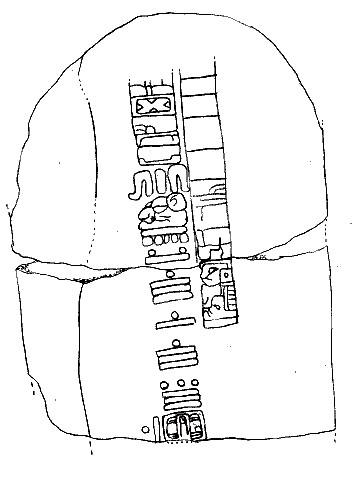
So to convert a Long Count date to the Western calendar, we first convert the Long Count to an integer (trivial: it's already just an integer written in base 20-except-18-in-the-penultimate-digit), we add a constant (C) to get a Julian Date, and we convert to our messy calendars.
BUT! What is this constant C? This is known as the “Mayan correlation”. For a long time in the 20th century there was a debate about its value: scholars could relate any two Mayan dates, but not situate them exactly w.r.t. our own calendar. Various values were proposed, ranging from the (frankly rather ludicrous) 394 483 to 774 078, an interval of about 1000 years! (😅)
https://bsky.app/profile/gro-tsen.bsky.social/post/3meiqswj7b22a
(4/n)