The ancient educational poem "Three Character Classic" contains many lines that are not self-explanatory, but are meant to remind you of a story:
昔孟母,择邻处;子不学,断机杼。
Hyperliterally: Once Meng('s) mother chose a neighborhood (in which to) dwell; (this) child (did) not study, (and so she) broke (her) loom. (Every third character rhymes in Middle Chinese.)
My rhyming translation:
Mother Meng, she knew it well: a home can seal a child's doom; and when her child would not learn, she tore the threads upon her loom.
My translation of the story this verse points to, as told in a modern children's edition by 胡媛媛 Hu Yuanyuan:
In the time of the Warring States, 2300 years ago, there was a man named Mengzi (Mencius) who was later deemed the "Second Sage" – the first being the founder of his school of thought, Confucius. If not for the long, hard work of his mother to see to his education, the great sage would have found it difficult indeed to become so great!
When Mengzi was four or five years old, he lived next to a graveyard. Every day there were mourners, weeping and wailing, draped in sackcloth, holding funerals or cleaning old graves. Little Mengzi thought it was all a game, and would hang out in the graveyard all day. Mother Meng saw this and immediately packed up and moved into the city.
But now they lived next to a butcher, and little Mengzi was fascinated by watching pigs be slaughtered and didn't want to go to school. Mother Meng saw this and again moved house, right next to the school.
Now little Mengzi saw students, and he would pick up their books and nod along thoughtfully as if he understood. Mother Meng was satisfied that she had found the right place to live.
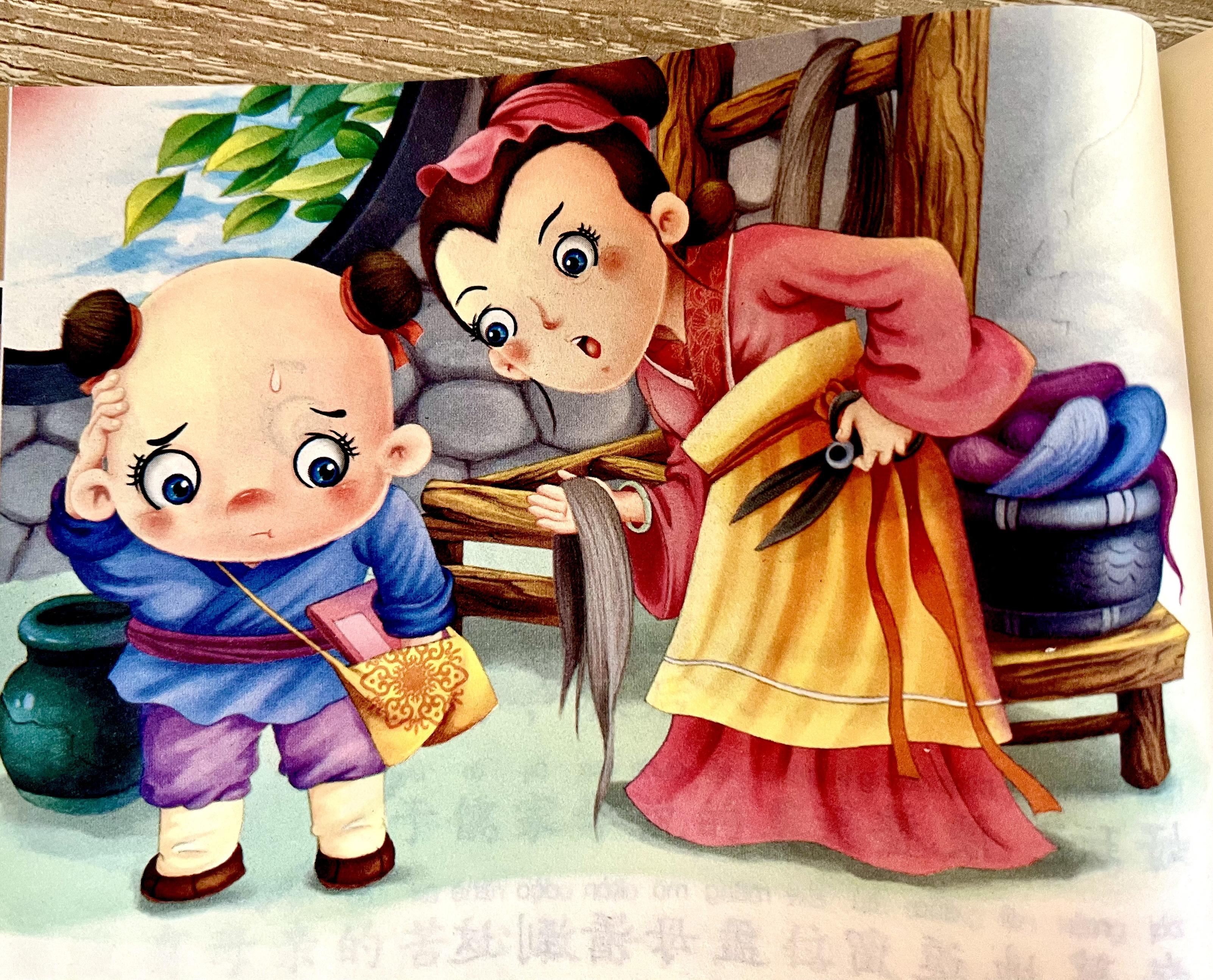
But one day, Mengzi skipped school. He came home while his mother was weaving; she could tell that he had skipped out, and was furious. She took her scissors, cut right through the threads on her loom, and gave him an earful: "You studying at school is like me weaving cloth: it builds up little by little. Breaking off halfway through is a complete waste of effort!"
Mengzi was deeply ashamed when he heard this, and went straight back to school with renewed determination. In the end, he became one of the world's greatest philosophers.
(The story doesn't spell this out, but his father was dead; his mother was raising him alone. Presumably she was living by the graveyard outside the city gates because it was cheap, and moving closer to the school implies loooong hours of weaving to barely pay for it.)