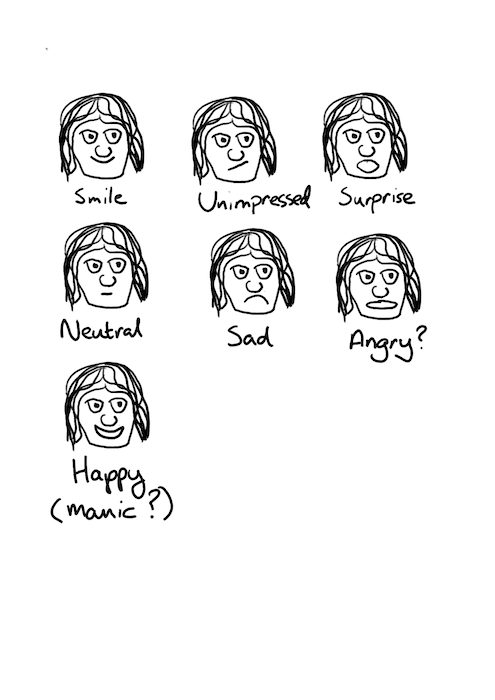
Rapid fire character with multiple emotes practice. #krita is looking a great tool for this kind of work, although its huge power and flexibility might make it hard to introduce to some of our younger #visualnovel authors.

@mavnn @Bonfire although i've never got around to learning Ruby i've always liked it, and the community.
but this kind of thing just makes me love Zig even more. the ability to reliably look up stuff in completely unknown codebase (especially with `zig fmt`, you can basically just `grep "fn some_function\\b"`) is a well guarded feature in zig

@[email protected] @[email protected] Yeap, zig had been on my short list to learn for a while now and that is one of the main reasons (along with comp time and solid cross compilation).
1
@[email protected] oh, nice package. I hadn't spotted that existed.
There is something about Ruby that makes me completely incapable of finding anything in a Ruby on Rails code base. Firstly, everything is arranged with according to conventions I don't know. Not my preference, but that I could learn or look up. But then there's also vast amount of stuff that just appears out of nowhere.
For instance, currently I suspect there's a mismatch between the url sent by @[email protected] in a Mention tag on an activitypub activity, and the result of calling short``account``url on a Mastodon account model for a remote account. But... there is no function called short``account``url in the Mastodon code base, it doesn't seem to be one of the standard Rails Router helper methods, it just... gets called in a bunch of places and ✨️magic✨️ occurs.
@[email protected] Erm. Looks like I've also found a weird bug in the markdown to HTML translation in social 1.0.2, by the way. The double backticks above in the function names were typed as underscores.
There is something about Ruby that makes me completely incapable of finding anything in a Ruby on Rails code base. Firstly, everything is arranged with according to conventions I don't know. Not my preference, but that I could learn or look up. But then there's also vast amount of stuff that just appears out of nowhere.
For instance, currently I suspect there's a mismatch between the url sent by @[email protected] in a Mention tag on an activitypub activity, and the result of calling short``account``url on a Mastodon account model for a remote account. But... there is no function called short``account``url in the Mastodon code base, it doesn't seem to be one of the standard Rails Router helper methods, it just... gets called in a bunch of places and ✨️magic✨️ occurs.
5
@[email protected] @[email protected]
> In a tragedy, the bad thing could be averted, but isn't, because the protagonist would have to act against their own nature to avert it. This gives tragedy its sense of inevitability and makes it so fun to read.
I think this is the difference though: if you don't have the conversation because of a character flaw, that's tragedy. If you don't have the conversation because you get interrupted by a series of increasingly contrived coincidences you have at best a weak farce.
> My sympathy for having been stuck on the inside of real-life failures, though. Seeing large corporations fail to do what must be done is the reason I've always avoided management jobs and just been a senior IC. You are made of sterner stuff than me if you risked that, and I'm sorry to hear it treated you that badly.
Thank you, but I'm not made of that sterner stuff either! Part of the problem/the saving grace was that I didn't go into management, I was supposed to be an IC with training and education responsibilities. But training one type of good practice/workflow doesn't work if the manager who wanted the training done is no longer in the position to actually push doing the things that are being trained (and the new manager is actively pushing other ways of doing things that are fine in themselves, but clash with what you've been asked to teach people)
@[email protected] @[email protected] Which is where this type of conflict is so rich for stories! Nobody in the situation was "wrong", but several players were set up with conflicting information, backgrounds, and incentives and suddenly no person is wrong but every thing is wrong.
1

I think what you're describing here is, basically, the concept of tragedy.
Othello could solve the plot of his play in thirty seconds, simply by realising that Iago is an asshole. He does not do this, because trusting Iago is part of Othello's identity. Hamlet could solve the plot of his play in thirty seconds, simply by not being an overthinker stuck in analysis paralysis. He does not do this because that's who he is.
In a tragedy, the bad thing could be averted, but isn't, because the protagonist would have to act against their own nature to avert it. This gives tragedy its sense of inevitability and makes it so fun to read.
That isn't to say that all tragedy is well done, of course. Like all dramatic forms, it can feel really unsatisfying when done by a hack. But when done well, it feels great because we can shout at the screen "NO DON'T TRUST IAGO HE'S LYING" while at the same time understanding why the protagonist does trust Iago.
There's no reason why this can't be applied to institutions too. We are, arguably, living through a tragedy in which Microsoft has been built into a cult by Nadella (first the cult of agile, then the cult of LLMs) and cannot save itself because that would require it to behave non-cultishly.
My sympathy for having been stuck on the inside of real-life failures, though. Seeing large corporations fail to do what must be done is the reason I've always avoided management jobs and just been a senior IC. You are made of sterner stuff than me if you risked that, and I'm sorry to hear it treated you that badly.
@[email protected] @[email protected]
> In a tragedy, the bad thing could be averted, but isn't, because the protagonist would have to act against their own nature to avert it. This gives tragedy its sense of inevitability and makes it so fun to read.
I think this is the difference though: if you don't have the conversation because of a character flaw, that's tragedy. If you don't have the conversation because you get interrupted by a series of increasingly contrived coincidences you have at best a weak farce.
> My sympathy for having been stuck on the inside of real-life failures, though. Seeing large corporations fail to do what must be done is the reason I've always avoided management jobs and just been a senior IC. You are made of sterner stuff than me if you risked that, and I'm sorry to hear it treated you that badly.
Thank you, but I'm not made of that sterner stuff either! Part of the problem/the saving grace was that I didn't go into management, I was supposed to be an IC with training and education responsibilities. But training one type of good practice/workflow doesn't work if the manager who wanted the training done is no longer in the position to actually push doing the things that are being trained (and the new manager is actively pushing other ways of doing things that are fine in themselves, but clash with what you've been asked to teach people)
4

@mavnn Yes, exactly. Whereas it's much harder to break out of the Abilene Paradox, to which groups or committees are susceptible, so it makes for *great* widescreen tragedy in fiction:
@[email protected] Having been twice made responsible for institutional change in the workplace and then having the person who appointed me lose the authority to push the changes, I have a painfully direct experience of how tough it can be to break out of the Abilene Paradox with a group that has someone well spoken and charismatic in authority who doesn't understand what's happening in the rest of the group. Lots of well meaning people doing things that seem sane, rational, and empathic individually, leading to a Not Good™ and emotionally distructive overall situation.
Hmm. I think I'm leaking my trauma. But it definitely makes for a stronger plot than 'I need to delay the PoV character five minutes or the entire story ends because they can have a conversation.'
6
#WritersCoffeeClub 17 Apr (3/3)
THAT sort of misunderstanding happens in real life and works fine in fiction.
The sort of misunderstanding that doesn't work in fiction is one that relies on individual protagonists being idiots, or failing to have the thirty second discussion that would clear the air instantly. Which is all too common!
@[email protected] I think these 'stupidity dependent' misunderstandings are tempting partly because they are easy, but also because they are easy to justify as 'realistic' because we have all seen people being stupid in relationships. But they fundamentally aren't satisfying because we can see how easily the conflict could be resolved from the outside, sort of a deus ex machina in reverse.
8

@[email protected] thank you. Also, I am sad. Next round of debugging when I'm not doing the washing up.
"Your encouragement for the day is trout ala creme, enjoy your physics!"
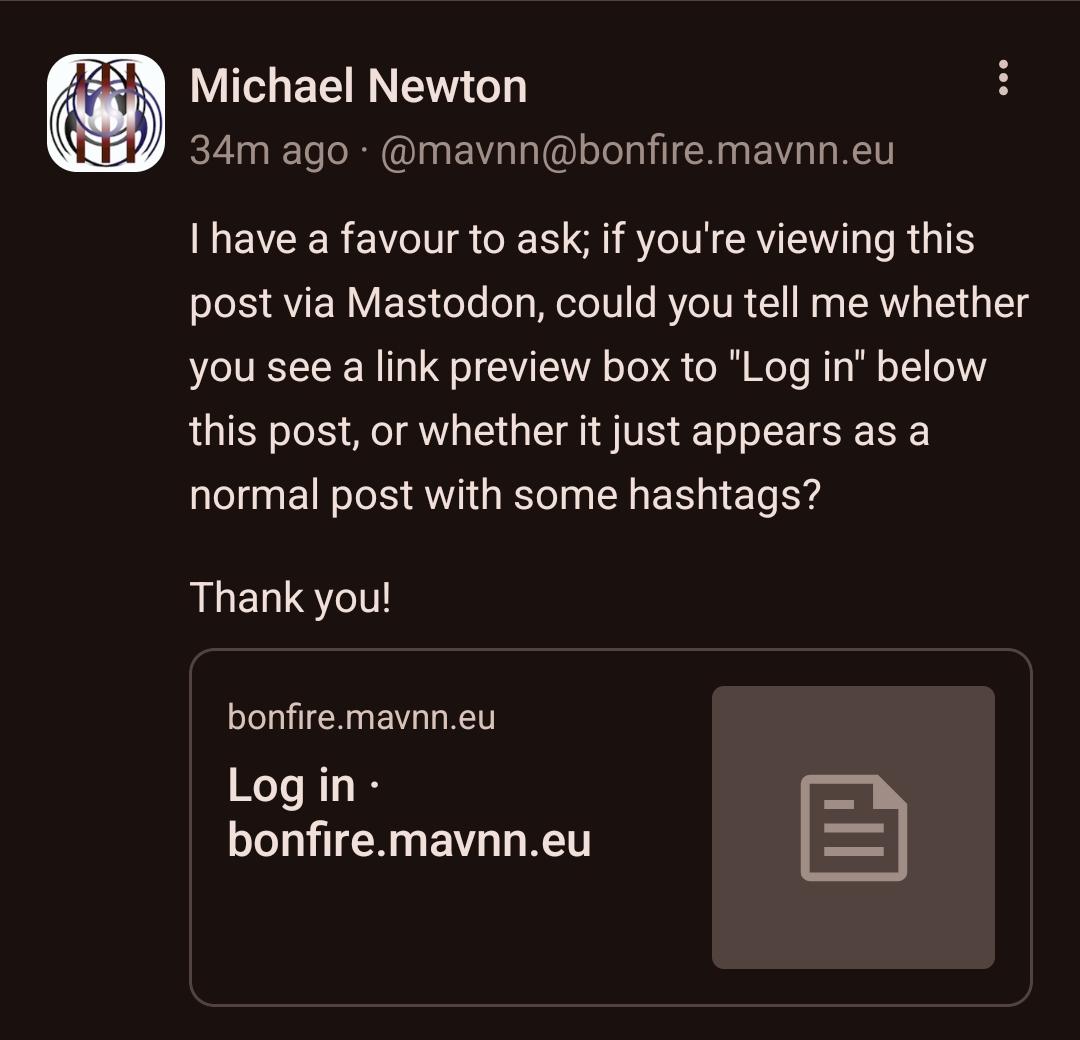
I have a favour to ask; if you're viewing this post via Mastodon, could you tell me whether you see a link preview box to "Log in" below this post, or whether it just appears as a normal post with some hashtags?
Thank you! #testtag
2
@mavnn "log in?"
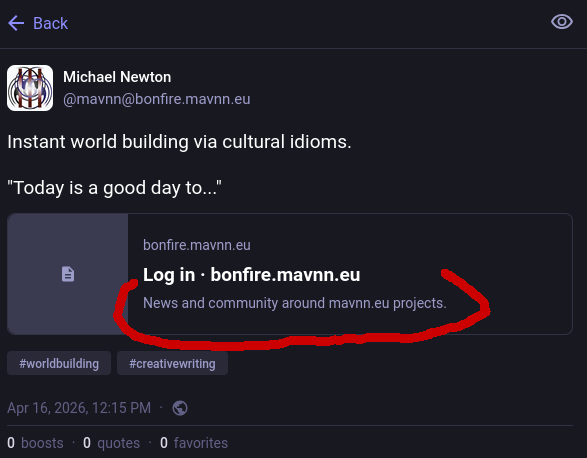
@[email protected] hmm. Thank you for letting me know, looks like Bonfire and Mastodon handling hashtag links differently. I'll have to see what I can do about that.

sometimes i wish i can make a commit "intent", like, a pre-commit message saying what im trying to do. i have their super weird experience where once i'm done with my commit, i flush all memory of what i'm doing and have to look at diffs to remember. you'd think i was making large commits, but nope. just me?
@[email protected] I think this is actually how jujutsu is designed to be used github.com/jj-vcs/jj (and it can be used in existing git repositories). This isn't a recommendation, I haven't tried it myself yet, but I found the suggested workflow interesting partly for the reason you state ("have I actually done what I meant to do? What did I mean to do?"), and partly for the next morning issue ("I know I was in the middle of something yesterday...")
1
@[email protected] not making IP6 at least partially backwards compatible, or at the very least presenting a visually 'compatible' representation, has got to be one of the largest self owns in computing standards history. @[email protected] @[email protected] @[email protected]
Instant world building via cultural idioms.
"Today is a good day to..." #worldbuilding #creativewriting
"... change my mind"