I'm currently running online sessions on how to create your own 2D art assets for teens, and leading to the following exchange:
Student: "Everyone who didn't sign up for this course is missing out on greatness!"
Me: looks silently at the greatness
Discussion
The official news and updates account for the VisualInk project.
Learn to create your own visual novels, and then share them with friends.
I'm currently running online sessions on how to create your own 2D art assets for teens, and leading to the following exchange:
Student: "Everyone who didn't sign up for this course is missing out on greatness!"
Me: looks silently at the greatness
Another fun session teaching Ink yesterday, having a look at the two mirrored twins of short cut syntax: threads (for reusing the same choices in lots of places) and gathers (for quickly adding choices that will only ever be used in one place). One of the students is looking to build a basketball based visual novel and found it really helpful to have the two ways of thinking about the parts of his game; the mechanics of playing basketball will be built of lots of threads, with options coming and going depending on the state of the game, while conversations and dialogue will be built with gathers allowing for lots of specific context and helping the dialogue not sound repetitive. And we expanded out the LIST driven example from last week to start using some of the things we'd learned. #VisualNovel #GameDev #InteractiveFiction
Did you know you can publish your #VisualNovel from VisualInk to be played on Itch, allowing you to build a community or submit it to a game jam? No? That's probably because until now you couldn't.
But now you can. We have instructions and everything. #GameDev #InteractiveFiction #GameJam
This week in our #VisualNovel course we looked at using LISTs in #Ink to keep track of what is going on in our game.
If you're curious, you can both playthrough and view the Ink script for the example we were working through, using lists to keep track of things like which spells the player has available and which party members they have with them. #InteractiveFiction #GameDev
Distributed computing strikes again; we've had to temporarily disable shared editing on VisualInk because under certain conditions the host (which included sessions with just one user, i.e. normal editing) could end up deleting some of their own work in a race condition. Ironically, updates from invited guests seemed to be always handled correctly.
We'll try and turn it back on soon, but data loss is one of those things we'd prefer to avoid even if it means disabling some functionality for a moment. Apologies if you were hoping to use the collaborative tools in the next few days 😞
The fun thing about running the same course more than once is that you get to see how differently the same ideas turn out based on questions asked, how quickly people work, delays from technical issues, skills growing...
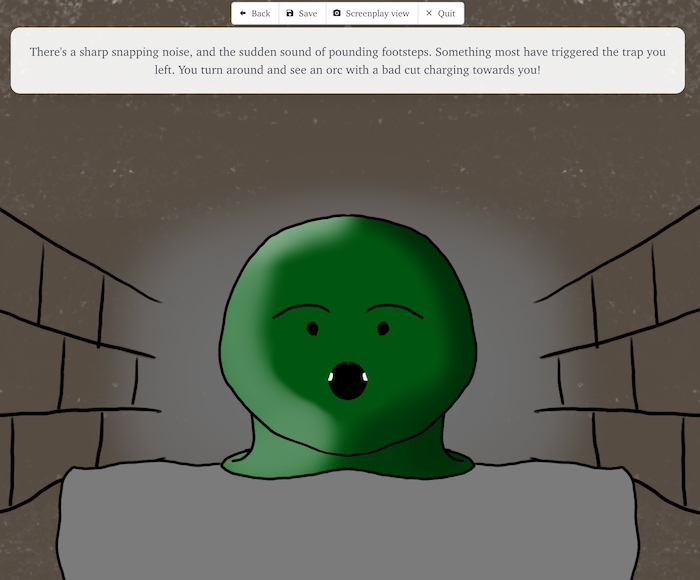
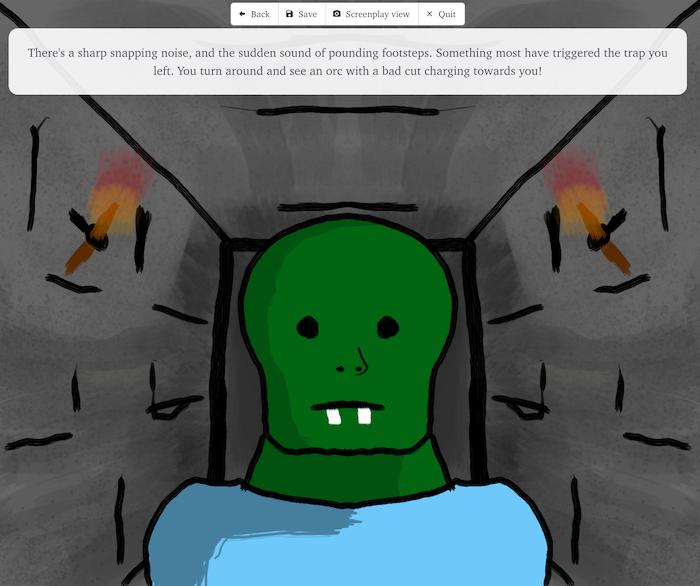
So now we have multiple orcs and multiple corridors. Got a preference? #GameDev #VisualNovel #Play #Krita
Okay folks! Next week I'm starting online 5 week courses for 11+ year olds on writing #InteractiveFiction and creating 2D art assets for #GameDev.
These courses are good! They are not expensive! I've run them a few times now, so they're reasonably polished! I've just had a generous offer towards a bursery so I can accommodate one or two free or reduced cost places! They involve less exclaimation marks than this paragraph (disclaimer: may depend on the character of the students who take the course)!
But: next week. That means if this sounds interesting, you need to act reasonably quickly. Given the bursery this time around, please also share to people you know who would be interested but wouldn't normally be able to cover the ~£66.00 cost. More here: thinkersmeetup.com/scholars/...
Last week, I worked with a small group of 9-14 year olds to build a game almost, but not totally, unlike space invaders.
It is quite silly. And the week of first time #gamedev was great fun.
If you're looking for a silly and simple #godot project, the code is at code.mavnn.eu/mavnn/michael-...
YouTube
I was teaching some 11-14 year olds to write choice based #interactivefiction this year, and at one point in the course I ask if there are any #ttrpg players (answer: always yes so far).
Then I propose that choice based fiction has a lot in common with with #ttrpg but one huge difference that changes everything for the author/GM: the magic moments in #ttrpg are when the players have their characters solve a problem in a way the GM never thought of, but is perfect for those characters in that game. While the magic in choice games comes when the author offers a choice the player would never have thought of, but is perfect in light of the choices made in this play of this game.
Which means in #ttrpg your role as GM is to encourage the explosion of possibilities, while in choice it is to make all the possibilities special (which requires them to be limited).
Interestingly, they all agreed without hesitation that unexpected in character problem solving was exactly what was magic in #ttrpg compared to #crpg
I'm going to be running a week long, online, introduction to #GameDev at the beginning of August using #Godot for 12-16 year olds. Details below!
The Arcade Games of the Future
Games don't need to be complicated to be fun to play, and back when computers had less resources to work with game designers had to lean hard into that truth by creating games that focused on just one thing: good game play.
Learn from the old masters of game design as we use basic techniques to create replicas of the old classics, using the modern game engine Godot to build games in the style of space invaders, breakout, and classic side scrolling platformers. But we won't stop there: unlike the original creators of those games, we aren't limited to the capabilities of the earliest computers, so we can start adding our own unique twists and visual wow factor to the games once the basics are working.
You will need a computer that can run Godot to take part in the course, but don't worry - you don't need a super powerful gaming computer to run it. You don't need previous experience of coding to take part, but we will be writing actual code for a full game engine, so you will need to be comfortable doing some typing. It would also be helpful to have a good understanding of how 2D coordinates work (i. e. using x, y pairs to position things). If you have taken my 2D art assets course or otherwise know how to make sprites, there will also be the opportunity to customise the look of your own versions of each game - but starter art will be provided to let us get going quickly.
How many games can you make in a five day course? Why not join us for a week and find out.
The Arcade Games of the Future will run 3rd-7th August at 16:00 UK time, and each session will last for one hour. You'll get the most out of the course if you carry on pushing the games forward in between sessions and come to the next session with any questions or stumbling blocks you hit, but there's no 'homework' as such.
Final session of my "Making 2D Game Assets" course today where we talked about recording sound for your game which is always great fun.
The final wrap up had some fun resources so I thought I might as well share it here as well!
Remember: the secret sauce of audio is always the same! Get as quiet a space as you can, and start by normalizing and reducing noise. Save that version before you do anything else, you'll thank me for it later.
How to create 100 distinct voices
This is a video from a voice coach on how to get started creating distinct character voices, starting with the easiest aspects to vary. youtube.com/watch?v=FVmAEezr...
Wing - Dopamine
We spoke about how flexible the human voice can be at creating sound effects just on its own. Wing takes this to world class levels, creating effects like this using only his voice, microphone positioning, and some reverb (the only effect allowed in the competitions he enters) youtube.com/watch?v=qlrpeYdm...
The Magic of Making Sound
This video gives a whole bunch of examples of Foley work. It does assume a certain amount of equipment you won't have available, but the basics are always the same: make sure you can see the video you want to match the sounds to, record the sounds, normalize and remove noise from your recording before setting the final volume you want. youtube.com/watch?v=UO3N_PRI... #GameDev #SoundDesign
YouTube
YouTube
YouTube
Using Ink in a #godot game? I built myself an Ink highlighter for Godot's script editor, and if you're feeling brave you can give it a try and help it get to a state where it can be published in the asset store (which would require at a minimum at least one Windows user telling me it works).
Occurs to me that by using polls I could make a play through of a #visualnovel on @VisualInk an #ActivityPub actor such that the first person picking each option span off a new save game down the new path (or even each vote triggered a reply to the vote on the new path given the novels can contain randomised elements). Sort massively multiplayer visual novels where anyone seeing a post could jump in and spin off a branch from the play through.
Short but sweet blog post today on tracking hidden consequences in #ink, responding to a question from my #visualnovel writing course.
On a totally related note, if you're looking to get into coding or fine tune your skills I'm currently able to take on a few more people/small groups teaching web programming (frontend and backend), basic game development with #godot, or narrative game creation for non-coders. I've got enough experience with the UK school system I can also help you present evidence to the local authority for home educators.
I've started doing some mentoring with general coding skills as well as the online VisualInk courses, so to avoid any privacy concerns (waves at current world situation) we now have a private code server where mentees can share their code (using #forgejo).
Given I now have the server, it also makes sense to start moving the rest of my open source code there. The first public repository? VisualInk itself: code.mavnn.eu/mavnn/VisualInk
I decided to try out an experimental design for ordered data in Ink, and learn more about the run time in the process.
I've blogged about the results with a bunch of examples, and I'm pretty happy with the outcome. Been looking for ways to include prioritization or limited resources like magic runes in Ink? This might be a good inspiration.
I'm running courses for under 18s on creating #interactivefiction (specifically, #visualnovels ) but I just had a request from one of the parents for an adult version of the course.
Would you, or anyone you know be interested in a short course on writing interactive fiction? Would probably run at around 5 hours over 5 weeks, homework optional, costing around 55 GBP.
More about me/the existing courses at thinkersmeetup.com/scholars/...
(Please share if this seems even vaguely interesting)