When I say that a High-Trust Trad adventure _consists of problems,_ and someone apparently translates that in their head to "includes some problems" or "could be said to imply problems."
1
When I say that a High-Trust Trad adventure _consists of problems,_ and someone apparently translates that in their head to "includes some problems" or "could be said to imply problems."
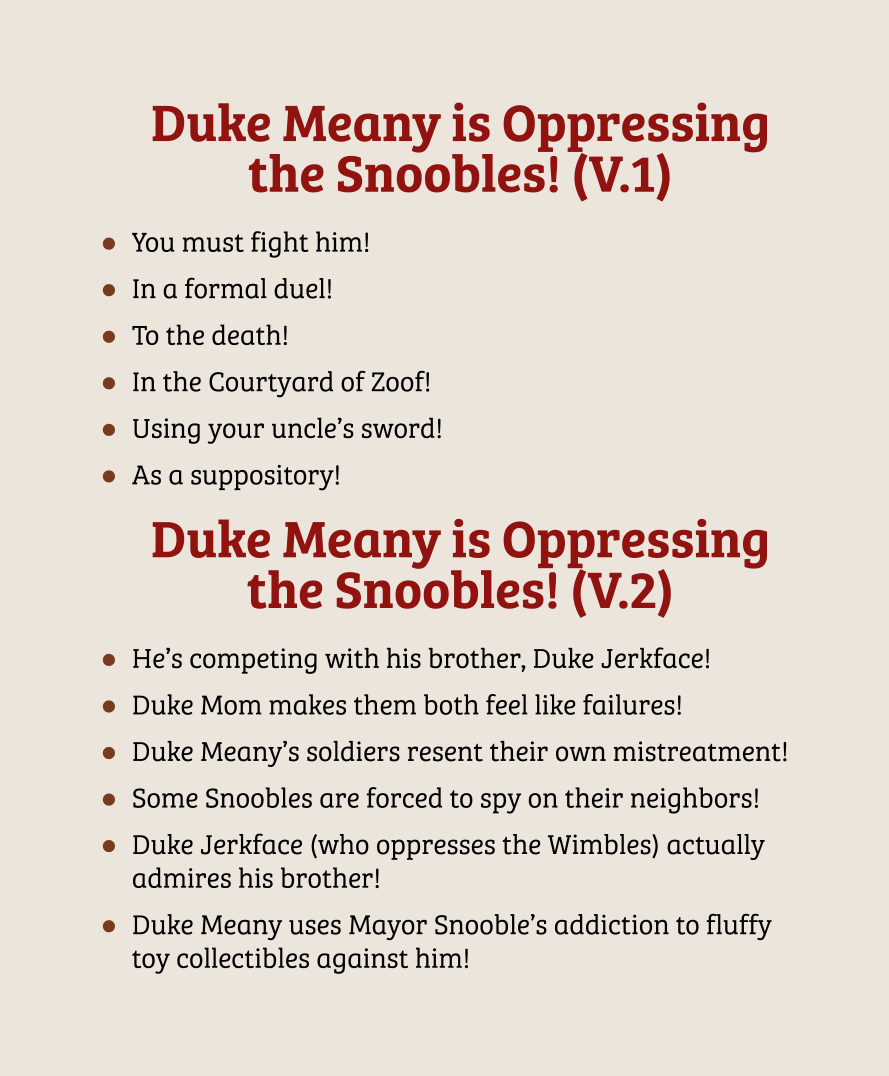
Let's try to cram #HTTRPG #AdventureDesign into one toot. The Duke Meany examples demonstrate a simple idea: Some facts constrict the viable range of PC approaches; some facts expand/multiply that range. In this context, we likey multiply-ey.
The Duke Meany examples have just six supporting notes each, which is enough for a seed but not quite enough to call a ready-to-run scenario.
But 30-90 well-designed notes? Solid one-nighter. Make it something the PCs will be passionate about.
I get annoyed with how much game designers put "hard choices" on a pedestal... in large part because this inevitably conflates choices that are difficult, meaningful, and/or consequential. Not only are those not that same, but the spaces between them are interesting!
Making something difficult is an easier design problem than making something meaningful, so you see a lot of games pretending the former is the latter.
@restlesshead I call them "Videogame Choices" when I write about #AdventureDesign, because they tend to be so dumbed-down, simplistic and arbitrary that even something as limited as a computer game can model them.
(As you might guess, I do not consider them good design, unless designing for preschoolers ... or actual videogames, of course)
I disagree that 'game designers' favor them, in any general sense. Some do, but some 'game designers' favor all manner of lazy things.