Biology is so wild. It doesn't respect the rules we make up.
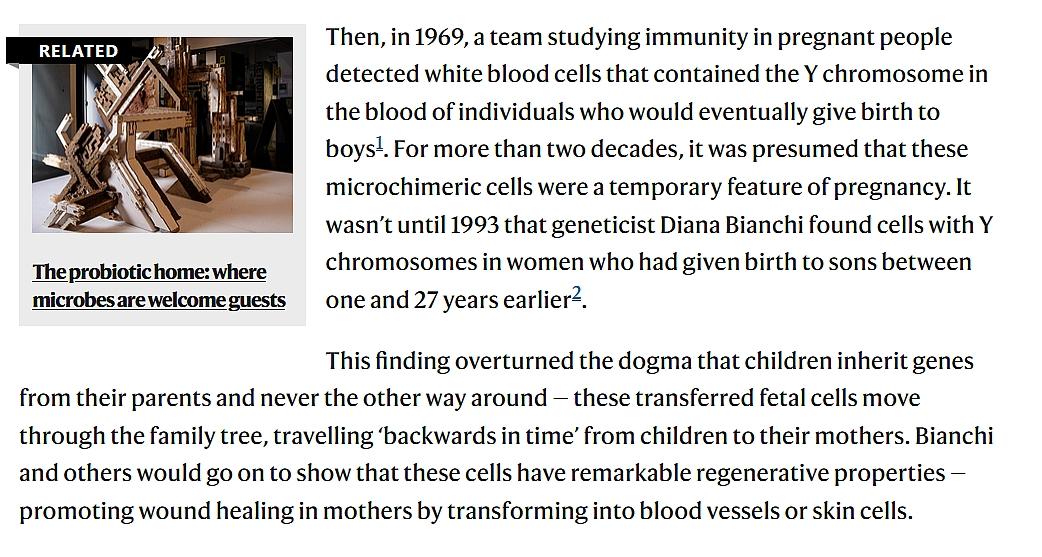
We all know children inherit genes from their parents. But it turns out mothers also inherit cells from their children!
And this can help them, promoting the healing of wounds. (But it may also hurt them, causing autoimmune disorders.)
For more, read this:
@johncarlosbaez@mathstodon.xyz
Quibble: substitute "cells" for "genes"!
I know you were simply sharing something you found fascinating (and thanks, the book does sound fascinating), but people look up to you as an authority, so…
We humans inherit a half-cell from each parent—this includes not just genes made up of DNA, but assemblies of proteins and carbohydrates and other molecules that make up a human cell. Given the half-century-long DNA-fetishism and gene-fetishism pervading our culture, I think this precision matters.
The description of the book under review also talks repeatedly about cells, not genes, being transferred (not inherited) from a child to its parent (and also from one human to another unrelated human, during transplants, transfusions, and sex). Sure, genes are functional components of those cells, but in these cases, the appropriate level of analysis is the cell.
#genes #proteins #biology #inheritance #cells